
All products featured are independently chosen by us. However, SoundGuys may receive a commission on orders placed through its retail links. See our ethics statement.
1 / 3Can the Hesh ANC stand up to pricier noise canceling picks?
A 3.1 puts its noise isolation / ANC in the bottom quarter of over-ear headphones we've measured.
Measured on 86 of the 240 we've cataloged.
below average for over-ear headphones — based on 150 of 240 we've cataloged.
Usb-c is the most common — on 87% of the 135 over-ear headphones we've cataloged (of 240).
5.0 appears on 8% of the 145 over-ear headphones we've cataloged (of 240).
Bluetooth is the most common — on 44% of the 215 over-ear headphones we've cataloged (of 240).
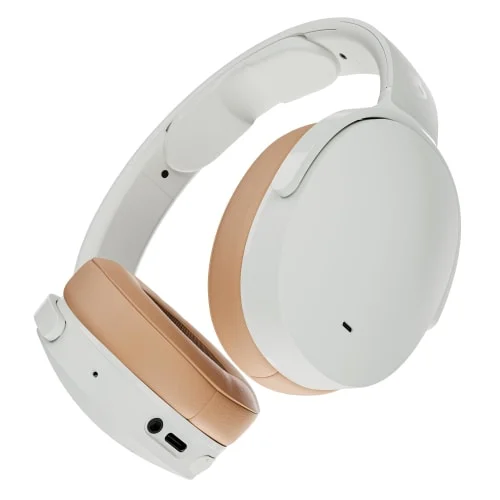
The Skullcandy Hesh ANC is a more affordable alternative for active noise canceling headphones (ANC). Its simple design is sure to have mass appeal and won't draw much attention. Battery life is above average, and you get efficient quick charging from the Hesh ANC. This pair of headphones hits the essentials while staying consistent with the brand's bass-heavy frequency response and cheaper materials.
Objective measurements from the SoundGuys test lab — overlay other models to see how this one compares.
Measured frequency response (dB) against the SoundGuys house target — the dashed curve. The closer the measured line tracks the target, the more neutral the tuning; peaks ride above the target, dips fall below it.
| Frequency (Hz) | Response (dB) |
|---|---|
| 20 | 15.7 |
| 25 | 16.8 |
| 32 | 11.7 |
| 40 | 8.1 |
| 50 | 6.0 |
| 63 | 4.4 |
| 80 | 3.5 |
| 100 | 2.8 |
| 125 | 1.8 |
| 160 | 0.5 |
| 200 | -1.0 |
| 250 | -3.0 |
| 315 | -5.0 |
| 400 | -6.3 |
| 500 | -6.8 |
| 630 | -6.0 |
| 800 | -2.9 |
| 1000 | -0.2 |
| 1250 | -0.9 |
| 1600 | 0.6 |
| 2000 | 3.1 |
| 2500 | 4.7 |
| 3150 | 10.4 |
| 4000 | 12.1 |
| 5000 | 11.2 |
| 6300 | 12.0 |
| 8000 | 10.5 |
| 10000 | 7.2 |
| 12500 | -1.5 |
| 16000 | 3.3 |
| 20000 | -18.9 |
Passive isolation (dB) with ANC off — how much ambient noise the fit blocks on its own. Higher on the chart means more attenuation.
| Frequency (Hz) | Attenuation (dB) |
|---|---|
| 21 | -5.0 |
| 26 | -0.6 |
| 33 | -1.1 |
| 41 | -0.9 |
| 52 | -0.5 |
| 65 | -0.5 |
| 82 | -0.9 |
| 103 | -0.5 |
| 130 | -1.1 |
| 163 | -1.3 |
| 205 | -1.6 |
| 259 | -1.4 |
| 325 | -1.0 |
| 410 | -0.1 |
| 516 | 0.5 |
| 613 | 1.2 |
| 772 | 3.8 |
| 972 | 9.0 |
| 1220 | 11.8 |
| 1540 | 15.2 |
| 1940 | 18.2 |
| 2440 | 25.7 |
| 3070 | 34.3 |
| 3870 | 24.3 |
| 4870 | 34.9 |
| 6130 | 29.0 |
| 7720 | 26.2 |
| 9720 | 18.4 |
| 12200 | 9.3 |
| 15400 | 25.7 |
| 19400 | 35.7 |
Total attenuation (dB) with ANC on — passive isolation plus active noise cancelling. Higher on the chart means more attenuation.
| Frequency (Hz) | Total attenuation (dB) |
|---|---|
| 21 | -15.4 |
| 26 | -11.3 |
| 33 | -2.2 |
| 41 | 3.7 |
| 52 | 8.9 |
| 65 | 12.6 |
| 82 | 14.4 |
| 103 | 18.2 |
| 130 | 15.7 |
| 163 | 17.2 |
| 205 | 19.7 |
| 259 | 19.7 |
| 325 | 24.0 |
| 410 | 21.1 |
| 516 | 19.1 |
| 613 | 12.8 |
| 772 | 8.8 |
| 972 | 14.0 |
| 1220 | 12.4 |
| 1540 | 12.6 |
| 1940 | 11.6 |
| 2440 | 24.5 |
| 3070 | 34.6 |
| 3870 | 22.7 |
| 4870 | 30.4 |
| 6130 | 31.2 |
| 7720 | 29.7 |
| 9720 | 18.4 |
| 12200 | 9.4 |
| 15400 | 23.0 |
| 19400 | 30.5 |
Commentary and deep dives from the SoundGuys editorial team.