All products featured are independently chosen by us. However, SoundGuys may receive a commission on orders placed through its retail links. See our ethics statement.
The best budget over ear headphones
Save your cash with these great budget headphone picks.
March 11, 2026

Chase is Brand & Partnerships Manager at SoundGuys’ parent company Authority Media. He is the former Managing Editor of SoundGuys. As a founder of the non profit organization Music For Mental Health, Chase is also passionate in uncovering the ways music creation and listening can serve individuals and the community. You can find music he produces by searching his name on Spotify, Apple Music, and all other streaming platforms. Chase studied Commerce and Applied Music Technology at the University of British Columbia in Vancouver, Canada.
Finding a solid pair of over-ear headphones on a budget used to mean making big sacrifices—tinny audio, flimsy builds, and nonexistent comfort. But not anymore. Today, you can get impressive sound quality, long battery life, and even features like Bluetooth or noise cancellation without spending a fortune. We’ve tested dozens of budget-friendly over-ear headphones, and there are now several options we can easily recommend.
Whether you’re looking for a comfortable set for working from home, something durable for the gym, or just a reliable pair to enjoy your playlists without breaking the bank, we’ve got you covered. These are the best budget over-ear headphones worth your money right now, as tested in the SoundGuys lab.
Compare table
Filter
- ProductVotes
- 83 total votes83 total votes
$80
8.3
7.2
8.1
6.7
9.5
8.0
7.7
7.5
9.9
9.5
8.5
- 34 total votes34 total votes
$100
8.2
7.1
8.0
6.5
9.0
7.5
7.0
9.0
9.8
9.0
8.0
- 5 total votes5 total votes
$80
7.9
7.2
8.0
6.0
9.5
6.0
7.0
9.0
9.9
8.5
8.0
- 5 total votes5 total votes
$85
7.8
6.0
8.0
7.0
9.0
7.0
7.0
8.0
9.0
8.0
8.0
- 7 total votes7 total votes
$80
7.8
6.4
7.5
6.0
9.5
7.0
7.0
7.5
9.9
8.0
8.0
- 12 total votes12 total votes
$84
7.7
7.0
8.1
6.5
6.5
8.0
7.0
8.0
9.8
8.0
8.0
- 8 total votes8 total votes
$59
7.7
6.1
7.5
6.9
9.2
6.8
7.0
7.5
9.9
6.9
8.2
- 3 total votes3 total votes
$99
7.6
5.7
6.9
6.0
7.7
7.0
7.6
9.0
9.9
7.9
7.0
- 6 total votes6 total votes
$99
7.2
3.0
7.0
7.0
7.0
7.0
8.0
7.0
9.0
8.0
7.0
- 2 total votes2 total votes
$99
7.0
7.0
8.3
6.5
3.0
7.0
7.5
9.0
9.7
6.0
6.5
- 5 total votes5 total votes
$86
6.9
3.0
0.0
7.0
8.0
7.0
7.0
7.0
9.0
8.0
8.0
- 2 total votes2 total votes
$61
6.9
6.3
7.3
5.5
8.0
5.0
7.0
8.0
9.9
7.0
5.0
Product chart
In the chart above, you can see how each of the headphones compares in terms of price and performance.
To gather information about how well each of the earbuds and headphones work, we subject each product to a number of objective tests. We use a Bruel & Kjaer 5128 acoustic measurement system to test headphones and earbuds in our SoundGuys lab. The ear canal of the artificial head was created by averaging and smoothing 3D models of individual ear canal features from the MRI scans of 40 different people.

We perform the following testing to determine the best headphones and best earbuds:
- We run sequences to determine the best fit of the headphones, and if there are any manufacturing issues with the product.
- We measure the headphones’ performance and compare the frequency response to our industry-validated SoundGuys Headphone Preference Curve to give context to readers.
- To rate sound quality, we use the Multi-Dimensional Audio Quality Scores (MDAQS) algorithm from HEAD acoustics. These are virtual mean opinion scores as calculated by a powerful machine learning model based on the input of real listeners.
- We play several samples of shaped noise over loudspeakers to test noise canceling and record with our artificial head. We take samples with ANC on, ANC off, and with the headphones off the head. After subtracting the appropriate curves from each other, we can see how well the headphones block out noise.
- To evaluate microphone quality, we play pre-recorded spoken Harvard sentences from a calibrated artificial mouth in our test chamber, either with or without simulated background noises, simulated reverberant spaces, or artificial wind.
- To measure battery life, we play back music through the headphones or earbuds peaking at 75dB(SPL), a safe and realistic listening level.
In addition to objective testing, our team of audio experts uses each of the headphones and earbuds to evaluate the experience of using the product. By wearing the headphones in day-to-day use, we evaluate the comfort, noting any pain points. We also make sure to try out each of the features that the headphones have to offer, such as using the equalizer in the companion app.
Using a combination of subjective and objective testing, we score each product. To learn more about how we evaluate headphones and earbuds, check out our in-depth explainer on how we test.

Here at SoundGuys, we’ve been testing audio products for over a decade. Our team comprises audio product experts who have tested hundreds of different headphones, earbuds, and speakers. Moreover, our team comes from diverse backgrounds and a wealth of expertise, including audio engineering, film production, journalism, podcasting, music production, and even touring musicians.
Everything we recommend results from our objective measurements and great subjective experiences. Ultimately, we want you to enjoy your purchase or, at the very least, leave our site with a little more knowledge about the inner workings of audio. To see why you can trust us with your purchase decision, make sure to check out our ethics policy.
Poll
How much are you willing to spend on good headphones?
Related Videos
Best overall pick: JLab JBuds Lux ANC


We pick JLab JBuds Lux ANC as our best overall choice for under-$100 wireless headphones because they balance solid battery life, usable ANC, and a useful app-driven EQ. The JBuds Lux ANC lasted 44 hours and 22 minutes in our battery test and supports fast charging that gives roughly four hours of listening from a ten-minute charge. They use Bluetooth 5.3 with Fast Pair and also offer wired listening over USB-C, while the JLab app provides a 10-band EQ and adjustable ANC modes to tailor the sound. ANC is decent for commuters — the ear cups create a strong seal and the headphones still manage useful cancellation, especially at higher frequencies. On our MDAQS charts the JBuds Lux ANC scored 4.5, reflecting strong bass and timbre for the price. This model also earned recognition for Best Value, Best Sound Quality, Best Battery Life, Best Over-Ear Headphones, Best for iPhone users, and Best for Comfort in the review.
Sourced from JLab JBuds Lux ANC review – SoundGuys.
Best Call Quality pick: Anker Soundcore Space One

We crown the Anker Soundcore Space One as our best call-quality pick thanks to its three-microphone array and AI processing that keeps voices clear in street and windy conditions. The Space One also supports LDAC and Bluetooth 5.3, which makes it a strong fit for Android users who want higher-bitrate streaming, and the Soundcore app adds an eight-band EQ and HearID personalization. In our testing the headphones delivered around 42 hours and 57 minutes of battery life with ANC on, and the app lets you tweak ANC strength or enable adaptive ANC as needed. Bluetooth multipoint and a comprehensive app ecosystem further reinforce its practicality for everyday use. This product also earned recognition as Best for Android users in the review.
Sourced from Anker Soundcore Space One review – SoundGuys.
Best ANC pick: Monoprice BT-600ANC
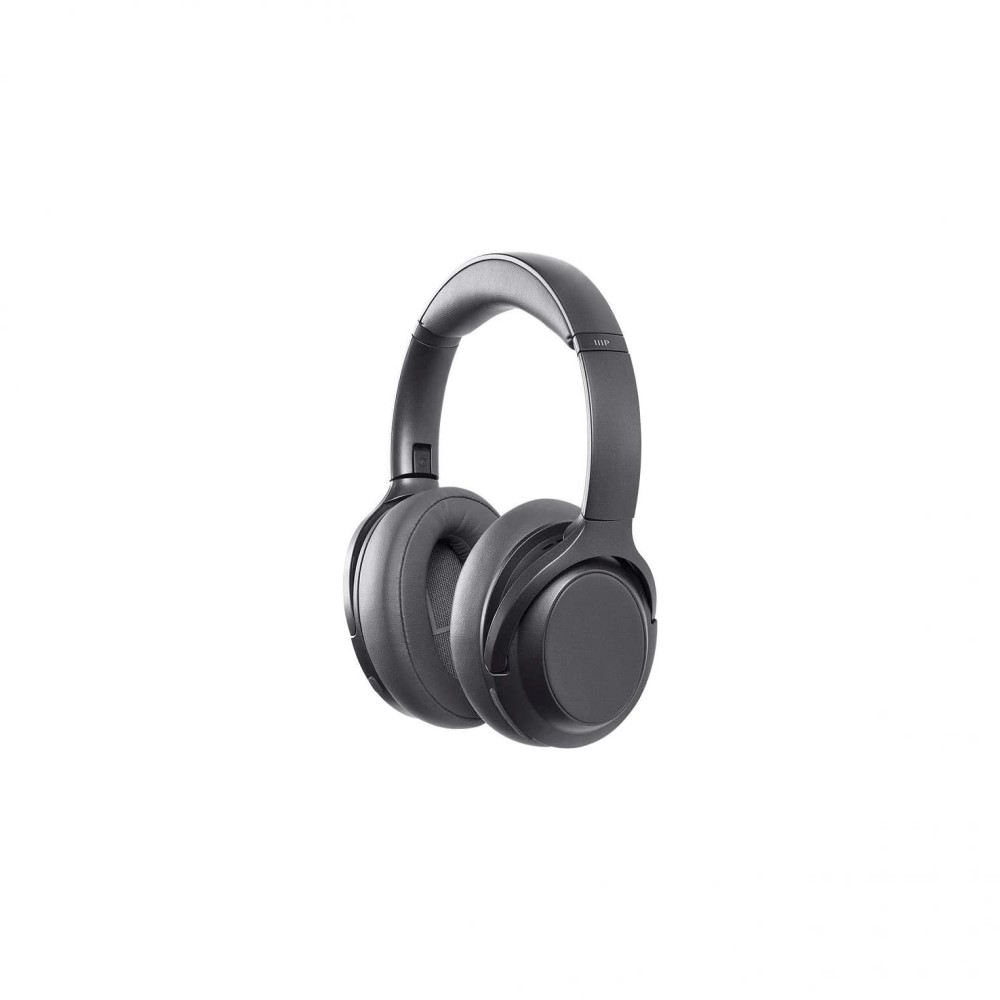

We select the Monoprice BT-600ANC as our best ANC pick because its active noise cancelation delivers a striking 20–30 dB reduction from about 30Hz to 1kHz, rivaling much more expensive models. The headset also benefits from leatherette ear pads that provide strong passive isolation, touch controls, and three distinct sound modes (ANC, ambient, and standard) for situational flexibility. In our battery test the BT-600ANC lasted 36 hours and 20 minutes with ANC on, and the headphones support aptX HD and AAC codecs as well as Bluetooth multipoint for easy switching between devices. The overall build is solid for the price and the ANC performance is the standout feature that earned this pick.
Sourced from Monoprice BT-600ANC review – SoundGuys.
Our verdict
Across sub-$100 wireless and wired headphone options, the JLab JBuds Lux ANC is our best all-around pick for commuters who want long battery life, an adjustable EQ, and competent ANC, while the Anker Soundcore Space One is the best choice if call clarity and Android-friendly features like LDAC matter most. The Monoprice BT-600ANC is the option to prioritize if top-tier noise cancelation is your primary need, thanks to its 20–30 dB reduction in critical low-mid frequencies.
For buyers considering the other models: the EarFun Wave Pro offers exceptional battery life (about 52.5 hours), LDAC support, and useful ANC but posts only middling MDAQS sound results; the Anker Soundcore Life Q30 is a versatile daily driver with about 46.5 hours of battery life, strong timbre and immersiveness scores, and a flexible app-based EQ and ANC modes; the Anker Soundcore Life Q20 is a utilitarian, effective ANC option with roughly 51.8 hours of battery runtime and basic wired support (microUSB charging); and the Raycon Everyday Headphones are comfortable, include a 3.5mm cable, and lasted about 23 hours in our test but exhibit variable sound across versions and more modest battery life. These summaries reflect the products’ strengths and limitations as tested for budget-conscious wireless and wired headphone buyers.
FAQ
Isolation refers to the ability of your headphones to block outside noise from reaching your ears. This might sound like active noise cancelation, but it isn’t. Active noise canceling uses microphones to pick up the sounds that are going on around you and then uses clever processing to cancel them out. In physics, it’s called destructive interference, and you can learn more about that in our article on how noise canceling works, but that isn’t what isolation is.
Isolation is simply having a physical barrier between your ears and the outside noises. Every time you stuff your fingers in your ears, you’re isolating yourself. You might hear certain loud noises around you, but for the most part, sounds are blocked out. A good pair of over-ear headphones can do something similar. They’ll cover your ears and block noises that would otherwise interfere with the music you’re listening to.
Not yet. While Bluetooth has become way better and more convenient in the last few years, it still can’t compete on a technical level with wired over-ear headphones. Sure, we might be a little biased against removing the headphone jack. Still, even our objective testing of the LDAC codec (which is arguably one of the top transfer methods currently available) revealed that Bluetooth falls short. Of course, you probably won’t have to worry about it too much if you’re over the age of 24 because our hearing tends to go a lot sooner than you might realize, but it’s still something you should be aware of. At least for now, wired headphones still reign supreme.
Over-ear headphones generally offer superior sound quality due to their larger drivers and better isolation, which minimizes ambient noise and allows for a more immersive listening experience.
Pros:
- Better sound quality
- Comfortable for long listening sessions
- Noise isolation/active noise cancelation
Cons:
- Bulkier and less portable
- Can be hot or sweaty during extended use
- Typically more expensive than in-ear models
Just like humans, headphones come in all shapes and sizes. Discomfort can arise from factors such as weight, clamping force, or ear pad material of the headphones. It’s crucial to find a pair that fits well for extended comfort.
Over-ear headphones are not necessarily any more or less healthier for your ears than other headphone styles. The ear cups sit around your outer ears rather than pressing directly on them like on-ear headphones. This can prevent air pressure buildup in the ear canal which can potentially lead to hearing issues over time with on-ear and in-ear headphone use at high volumes. Over-ear headphones also allow you to listen at lower volumes while still getting good audio isolation from outside noise.
Over-ear headphones (also called circumaural) have large ear cups that completely surround your ears. This design creates a natural seal, helping with comfort, noise isolation, and sound quality compared to on-ear or in-ear headphones.
Generally, yes. Large padded ear cups and adjustable headbands spread pressure more evenly than on-ears. However, comfort varies depending on weight, clamping force, and padding materials, so it’s worth checking reviews if you plan to wear them all day.
Not usually. They’re heavier and can trap heat during intense activity. Wireless earbuds or bone-conduction headphones are generally better suited for workouts.
- Noise cancellation:Especially useful for travel and commuting.
- Sound quality:Balanced tuning, or bass/treble emphasis depending on your taste.
- Battery life:For wireless, aim for at least 25–30 hours.
- Comfort: Weight, padding, and clamping pressure.
- Features:Multipoint Bluetooth, customizable EQ, transparency mode.
- Durability: Sturdy build and replaceable parts.
Thank you for being part of our community. Read our Comment Policy before posting.