All products featured are independently chosen by us. However, SoundGuys may receive a commission on orders placed through its retail links. See our ethics statement.
I tried these $1399 IEMs for gaming, and they perform better than expected
Oct 9, 2026 — 5:00 AM ET


The 64 Audio Solo is an open planar-magnetic IEM that sits squarely in the luxury price range. At $1399, it’s a ridiculous amount to spend on an IEM. We’re throwing the value-to-price ratio right out the window. I’m no stranger to luxury audio gear, such as the Focal Clear, which I bought at its original $1499 launch price. At those prices, I’m buying because something holds a specific interest I want to explore. For the Solo, that’s gaming performance, where IEMs are only getting more popular. So, do the 64 Audio Solos make the cut for gaming, or are they best for critical music listening?
What do you get at this price?

Even at exorbitant price points, you get the same accessories you’d get from most products under $200. The difference is typically in the materials and experience. The box is larger and fancier: a thick cardboard sleeve with a magnetic closure. Opening it reveals the IEMs, “HEAR EVERYTHING” in bold, and a hard cylindrical case. Personally, I could use less of the over-the-top presentation. Fortunately, “HEAR EVERYTHING” does match my listening experience. More on that when I talk about how it sounds.
The 64 Audio Solo comes with a small leatherette storage case that neatly organizes all the included tips, unlike cheaper products, where they are tossed into a plastic baggie. You also get two cables: a 4.4 pentaconn and a pre-installed 3.5mm TRS. Both cables are braided copper, malleable, and soft in the hands. They don’t hold their shape, which makes them much more comfortable than fighting a stiff cable. The cable cinch is too tight to adjust easily, but since it’s normally set-it-and-forget-it, that’s not a big issue.
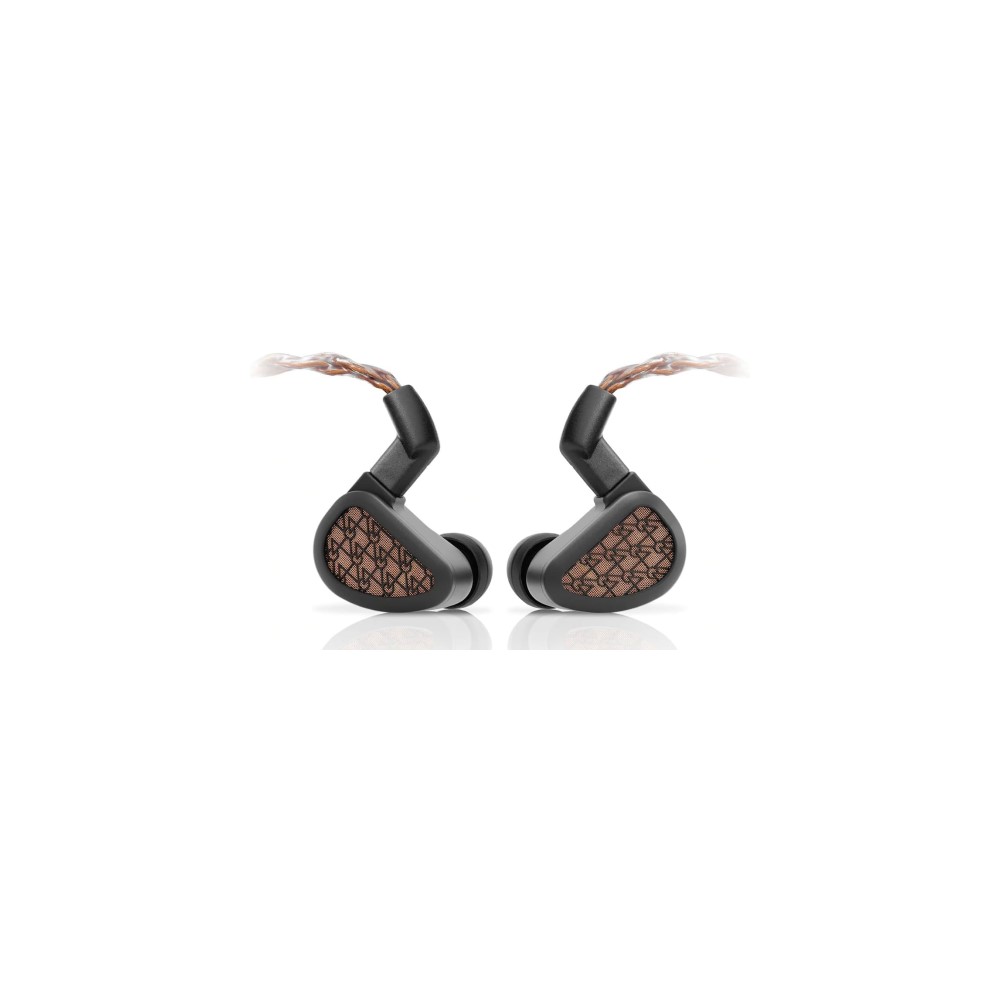
The IEMs themselves are gorgeous. It’s mostly the company logo, but I love the copper coloration and the pattern they’ve made of it. It looks abstract unless you know the brand, a real “if you know, you know.” The build is all-metal, with everything lining up closely; my only nitpick is a personal distaste for the 2-pin connector. They’re not fingerprint magnets, either, so unless you’re particularly sweaty, they’ll stay clean most of the time.
What does the 64 Audio Solo sound like for gaming?

- Timbre (MOS-T) represents how faithfully the headphones reproduce the frequency spectrum and temporal resolution (timing information).
- Distortion (MOS-D) represents non-linearities and added noise: higher scores mean cleaner reproduction.
- Immersiveness (MOS-I) represents perceived source width and positioning: how well virtual sound sources are defined in three-dimensional space.
The 64 Audio Solo scored decently on MDAQS, but fell just below the IEM category average of 4.4. This means that most people would rate the 64 Audio Solo as sounding very good, but not as absolute excellence. This is because MDAQS is meant to simulate an untrained listener. IEMs like the 64 Audio Solo target a specific sound for a specific crowd, not the general audience. Again, it didn’t perform badly, but as usual, more money doesn’t mean closer to perfection for most people.
Is spending over $1000 for a luxury audio product worth it?
Would I recommend the 64 Audio Solo?
At $1399, the 64 Audio Solo isn’t for anyone chasing a value-to-performance ratio. I’d recommend it to anyone who prioritizes sound clarity. They have a tuning that makes them perform exceptionally well in competitive games such as Marvel Rivals and Apex Legends. The clarity allows me to easily hear team communication and footsteps amid the noise of battle.
I do shop in the $1000+ range at times. So I am tempted to get the 64 Audio Solos purely because of the level of clarity the tuning provides. If you’re looking for a more palatable price on a great-sounding, competitive FPS IEM, take a look at the Oriveti BLEQK Dynabird for $99.99 at Amazon. They offer most of the experience you get from the Solos at a fraction of the cost. The Dynabird doesn’t have as much clarity as the 64 Audio Solo, but it is close to the directional precision of wall-hacks.

Thank you for being part of our community. Read our Comment Policy before posting.