All products featured are independently chosen by us. However, SoundGuys may receive a commission on orders placed through its retail links. See our ethics statement.
This one DAC replaced three boxes on my desk, and I'm never going back
Jul 8, 2026 — 5:30 AM ET


A midrange or high-end digital-to-analog converter (DAC) should be one of the last things you buy when crafting a desktop listening station. It’s not that external DACs don’t make a difference; it’s that the money you might spend on an expensive DAC could be better used elsewhere. I followed that advice as I built my own setups. I opted to invest in a Dolby Atmos speaker system for my living room and spent only $140 on the Fiio K11 amplifier and DAC on my desk.
Then, Fiio sent me the K15 to test — a $550 desktop DAC with all the bells and whistles you’d expect. It felt like a major upgrade over the K11 I bought for myself, although not because of sound quality. Sure, the dual AK4497SVQ DAC chips inside the Fiio K15 are superb at reproducing sound, but so are many other DACs. The features that made this DAC stand out were its versatile audio input/output support, 10-band parametric equalizer, and clever streaming integrations.
The Fiio K15 replaced three accessories in my setup

I don’t rely on a single delivery format or medium for listening to music — I use a mix of everything. I need analog inputs for my turntable and cassette deck, digital inputs for my CD player and Mac Pro music server, and network connections for wireless streaming. Few DACs or amplifiers check every box, so I turned to specialized accessories. A basic Fiio K11 DAC handled my computer and CDs, a Sony STR-DH190 stereo receiver took care of my analog sources, and a HomePod Mini sat on my desk for when I was too lazy to do anything but stream.
The Fiio K15 managed to replace them all, starting with the analog sources. I used RCA inputs to hook up my turntable, and the RCA outputs to connect my speakers. The analog inputs completely bypass the digital-signal processing pipeline, avoiding an unnecessary conversion. Internally, there are isolated circuit boards for the digital pipeline, analog inputs and outputs, and power supply. As I listened to music, the noise floor was effectively silent as a result.
I did wish for just one extra set of analog RCA inputs, but the K15 does make up for that limitation with a 4.4mm balanced analog line input. There are a slew of digital inputs here, too: USB-C on the front and back, optical Toslink, digital coaxial, and USB-A. I used a USB-C cable to connect my computer using 192kHz PCM audio, but this DAC supports up to 768kHz PCM audio. The optical cable ran from my CD player to the Fiio K15, leaving me with inputs to spare.

What’s neat about those digital inputs is that they all work with the Fiio K15’s built-in equalizer. With zero third-party software, I can set a custom EQ that applies to my digital sources, whether they’re CDs, digital files on a USB drive, or a computer.
This isn’t the only DAC or amp that offers a mix of digital and analog inputs — streaming is the final piece of the puzzle that makes the Fiio K15 stand out. It has Bluetooth 5.1 with support for high-quality wireless playback using the aptX Adaptive or LDAC codecs. It’s also a Roon Ready endpoint, so you can set up the Fiio K15 as a playback device for your Roon Server, which manages both self-hosted music and cloud-based streaming.
I primarily used the Fiio K15 wirelessly via Apple’s AirPlay 1, which supports 16-bit, 44.1kHz lossless playback. It would’ve been nice to see Google Cast support here, but you’ll have to choose between AirPlay, Bluetooth, or Roon. The good news is that there’s a 1-Gigabit Ethernet jack on the back, so I connected the Fiio K15 directly to my network with a cable rather than using Wi-Fi.
The touchscreen, knobs, and PEQ just make sense

The beauty of this DAC is that I can wire every audio source at my desk to a single amplifier, cycling through each one with an easy-to-reach knob. Before, I’d use different audio accessories or janky splitters to achieve a similar result with much more frustration.
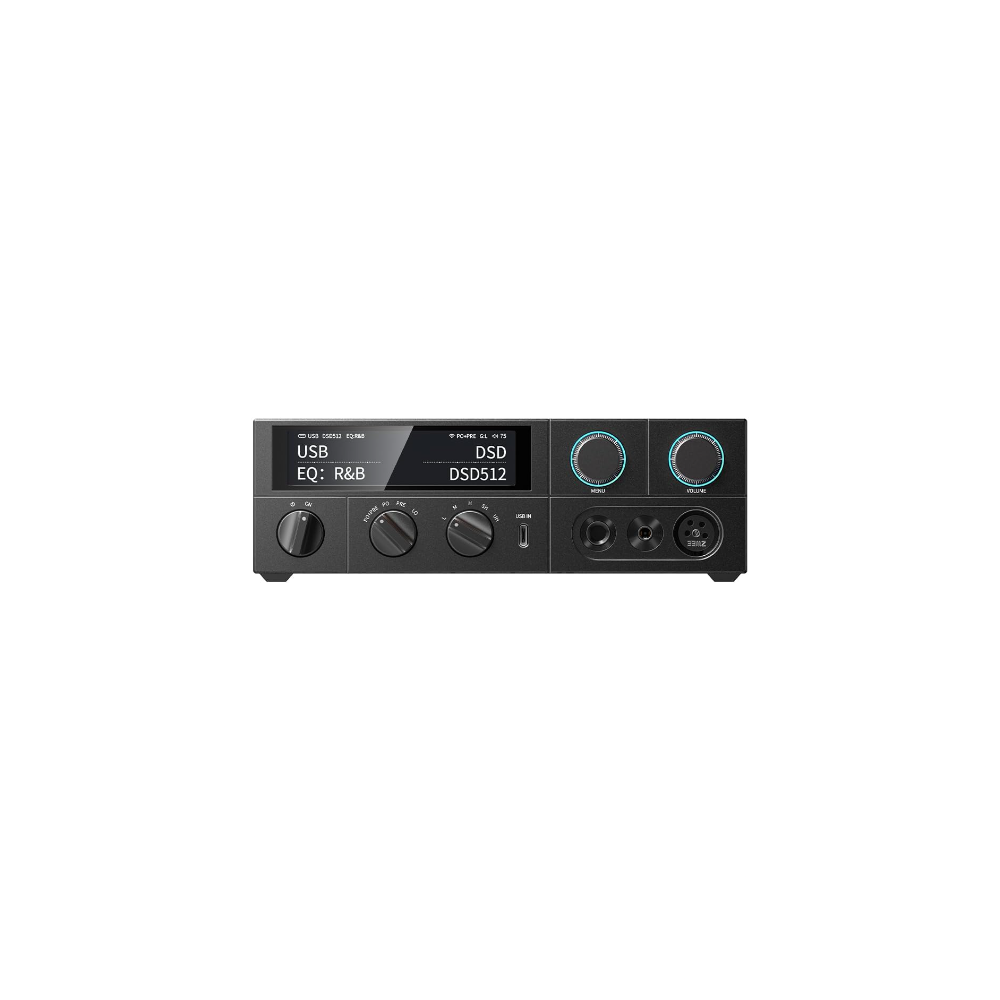
For those into the look of a beefy DAC, there are physical switches for power control, output selection, and gain selection. You also have menu and volume knobs that double as buttons. There is a remote in the box and desktop or mobile apps, but I stuck with the trusty knobs and switches most of the time.
They aren’t just for show — the knobs, switches, and 3.93-inch touchscreen gave me a ton of control over my sound. The highlight was the 10-band parametric equalizer, which can be applied to every digital source.
There are a handful of PEQ presets, but they weren’t impressive. The presets were predictable, with the “Hip-Hop” EQ overemphasizing bass and muffling the mids and highs. The “Rock” EQ practically did the opposite. But with a customizable PEQ, you can build custom EQ profiles in the desktop or mobile app and save them to the Fiio K15.

Aside from the PEQ, the five-level hardware gain switch makes switching between different outputs a breeze. I used a set of powered speakers, a pair of high-sensitivity Fiio FT13 headphones, and a pair of high-impedance Sennheiser HD 600 headphones with the K15 DAC. That gain switch helped me tailor the DAC’s output power to each channel without changing the volume setting.
All told, the out-of-the-box sound quality was fantastic. The Fiio K15 produces a warmer sound, and when paired with the above headphones at higher gain levels, I was seriously impressed by their imaging and instrument separation. I heard and focused on parts of songs I previously missed while listening to these headphones through this DAC.
What is the most you'd spend on a DAC?
This DAC is both affordable and out of reach

I want to say the Fiio K15 is too expensive at $550, but I can’t bring myself to. For one, it shares its design and key features with the Fiio K17, a premium desktop DAC that costs nearly twice as much. In my setup, the Fiio K15 replaced three audio accessories: the Fiio K11 desktop DAC ($140), the Sony STR-DH190 stereo receiver ($250), and the HomePod Mini ($100). Add up the cost of each one, and you get quite close to the Fiio K15’s price point.
This shows that the Fiio K15 is priced right for someone, specifically somebody who needs a desktop DAC that can handle a combination of digital, analog, and streaming audio playback effortlessly. It doesn’t necessarily mean this DAC is right for you. At nearly $600, this accessory condenses a stack of audio gear into something with a desktop-friendly footprint, but it’s a luxury for most people.
Thank you for being part of our community. Read our Comment Policy before posting.