All products featured are independently chosen by us. However, SoundGuys may receive a commission on orders placed through its retail links. See our ethics statement.
I built my own Dolby Atmos speaker system, but I still prefer headphones for music
June 25, 2026


Dolby Atmos for music listening is finally gaining traction. The spatial audio format is available on Apple Music, Tidal, and Amazon Music Unlimited, and it’s a key perk of these streaming services. Chances are, you have a phone, speaker, soundbar, or a pair of headphones or earbuds that support Dolby Atmos. One question remains — is it even worth using Dolby Atmos to listen to your favorite albums without a height-capable, surround-sound speaker system?
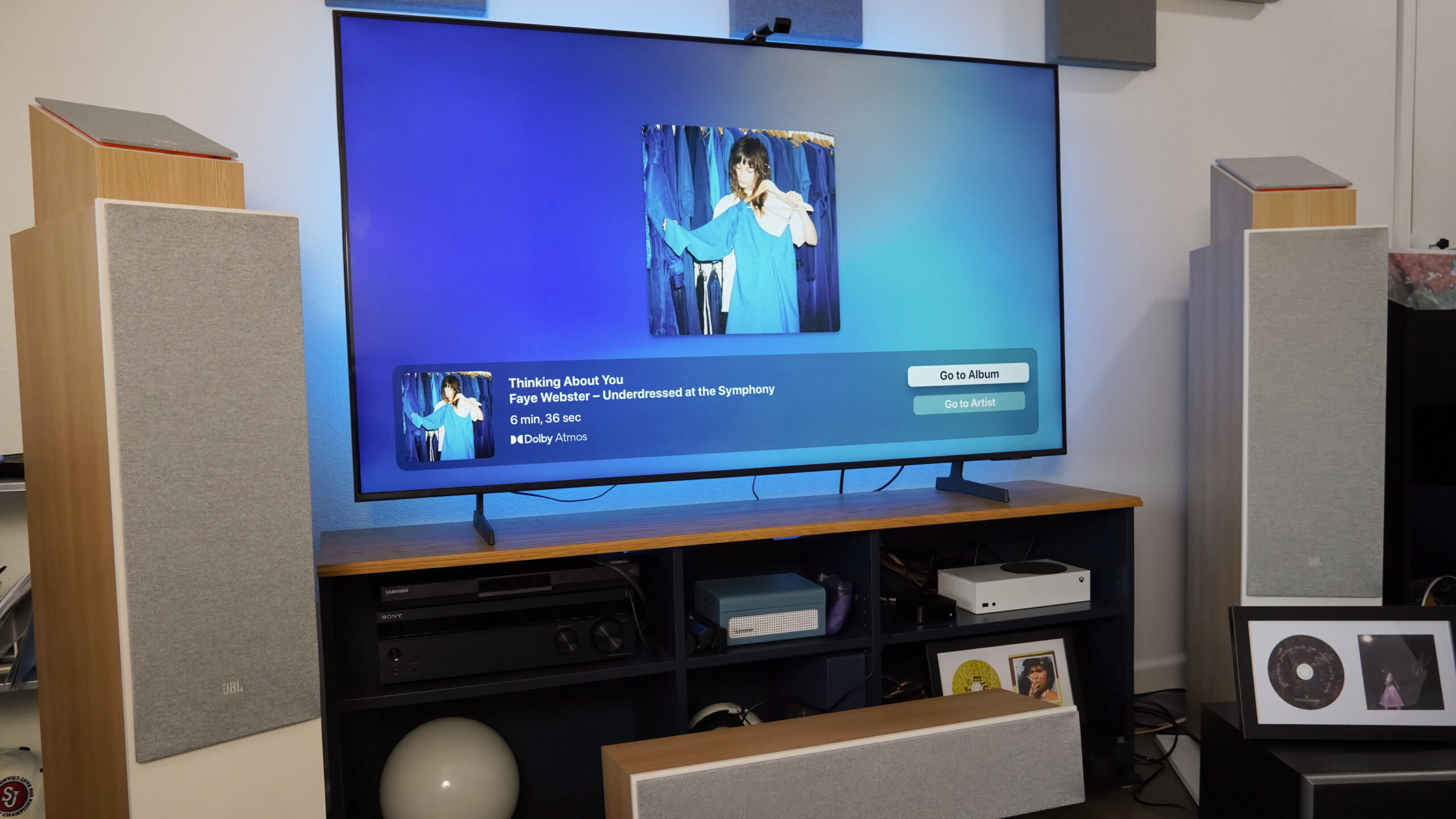
I spent years listening to Dolby Atmos tracks with earbuds, headphones, and speakers, but always wondered whether I was missing out on something better. After replacing my bookshelf speakers with front loudspeakers and realizing I was only a few pieces away from a true Atmos setup, I ended up building a 5.1.2 system. I’ve spent weeks listening to Dolby Atmos songs through my speaker system, and realized headphones might be better at spatial audio for music.
Dolby Atmos speakers were subtle compared to stereo
In the past, the ideal speaker configuration for music was generally accepted to be a 2.1 layout. Two front loudspeakers and a subwoofer were all you needed, as the vast majority of songs are mastered in stereo. Using a home theater system in surround mode with a two-channel master likely won’t sound as good as stereo mode. Dolby Atmos tracks are different. They are created as object-based masters, with sounds perceived as coming from around and above you.
Since Dolby Atmos mixes use object-based audio rather than channel-based audio, sounds come from specific positions in a 3D hemisphere rather than from particular speaker channels. This is how Atmos recordings create an immersive audio experience on both headphones and speaker systems. The Dolby Atmos renderer takes the original mix and adjusts it for playback across different gear, which also means the listening experience will vary based on the individual master and delivery format.
Listening to music in Dolby Atmos made me appreciate how spacious stereo audio can sound.
I expected a multi-channel speaker system to outperform headphones for Dolby Atmos playback, so I tested it. My setup included a JBL MA710 receiver, two front floorstanding speakers, two upfiring height speakers, a center speaker, a subwoofer, and two rear surround speakers. I used Apple Music to listen to songs I’m familiar with, comparing the Atmos listening experience to standard stereo. If I had to describe the listening effect in one word, I’d go with “impressive.”
Impressive doesn’t always equal better, though. The joy of hearing background vocals behind me or instrumentation overhead was real, but Dolby Atmos didn’t change how I perceived music. Finding moments when Atmos delivered a sound or spatial audio effect that stereo mode couldn’t was difficult. In fact, there were times when I had to double-check that my rear surrounds or height speakers were still playing.
If anything, listening to music in Dolby Atmos made me appreciate how spacious stereo audio can sound with proper speaker placement. I never reached for a Dolby Atmos streaming service; instead, records or CDs — both physical and digital formats in stereo — were just as enjoyable a listen. Dolby Atmos can sound impressive yet artificial, because I’ll never be in the center of a room with instruments and voices coming from all around me in real life.
Headphones shine with Dolby Atmos music

Dolby Atmos didn’t transform my speaker playback because it didn’t solve a problem. There is nothing inherently wrong or missing when I listen to 2.1 audio from my loudspeakers and subwoofer. Atmos added and changed things, but I wouldn’t call it an upgrade. Dolby Atmos solves a problem with listening to headphones in basic stereo, and that’s the difference.
When listening to music through headphones, the sound is generated by drivers right beside our ears. The brain struggles to pinpoint where the sound is coming from because the audio isn’t impacted by the shape of human shoulders, head, and outer ears. The head-related transfer function (HRTF) explains how we interpret the location of sound based on these acoustic clues, and headphones playing in stereo can’t provide them.
Dolby Atmos does solve a problem with listening to headphones in basic stereo, and that's the difference.
The result is a sense of internality when listening to certain headphones. This can be fatiguing on its own, and may be worsened when paired with the pressure of active noise cancelation. Dolby Atmos is the fix. When played back through headphones, Dolby Atmos uses HRTF processing to simulate sounds originating from around the head. Since ear shapes and sizes vary, the HRTF algorithms can be personalized to your ears.
This explains why I enjoyed listening to Dolby Atmos with headphones more than speakers. It’s not that headphones were better sounding or more convincing than the 5.1.2 speaker system — it’s that the binaural audio delivered through Dolby Atmos fixed my gripes with stereo. I could listen to headphones longer due to the spatial feel, which was less fatiguing than traditional stereo. The way I perceived music did change while listening to Dolby Atmos with headphones, as sound seemed like it came from all over, rather than from right next to my ears.
Personalized spatial audio with head tracking further refined the headphone-listening experience, whereas Dolby Atmos only sounded outstanding through my speakers when I was seated in the prime listening position.
How do you prefer listening to Dolby Atmos music?
Speakers cleared headphones easily for movies

I don’t regret investing in a Dolby Atmos sound system, because the speakers are downright stunning when watching movies and TV shows. After upgrading, the audio tracks that come with a film are just as exciting as the 4K HDR picture on the screen. The first time I heard the whirring of helicopter blades sound like they moved in front of me, above me, and behind me, I knew buying into Dolby Atmos was worth it.
For music, it’s a different story. The gap between stereo and Atmos sound is much wider when listening on headphones than on a speaker system. I’ll always listen to music in spatial audio with headphones, but I’ll stick with trusty stereo when listening through my floor speakers.

Thank you for being part of our community. Read our Comment Policy before posting.