All products featured are independently chosen by us. However, SoundGuys may receive a commission on orders placed through its retail links. See our ethics statement.

Shokz OpenFit Pro review: Noise reduction meets open-ear comfort
Jan 22, 2026 — 6:00 AM ET
Shokz OpenFit Pro


Open-ear earbuds sacrifice isolation for comfort and awareness, but the Shokz OpenFit Pro challenges that trade-off with the company’s first noise reduction system. It’s a feature that sounds contradictory on paper: how do you cancel noise without sealing your ears?
The OpenFit Pro also debuts a new dual-diaphragm driver claiming 50% more bass than previous models, plus a redesigned fit meant to address stability issues from the OpenFit 2+. After testing these for a couple of weeks, the noise reduction technology genuinely works, though it raises questions about whether this middle ground between isolation and awareness is worth the $50 premium over Shokz’s other open-ear models.
The OpenFit Pro are for people who want open-ear comfort and ambient awareness but need some noise dampening in moderately loud environments like offices or gyms. They’re ideal if you’ve found traditional ANC earbuds too isolating but still want to reduce background chatter.
This article was published on January 22, 2026, and this is the first version of the article. Updates will follow as the market changes.
What’s it like to use the Shokz OpenFit Pro?

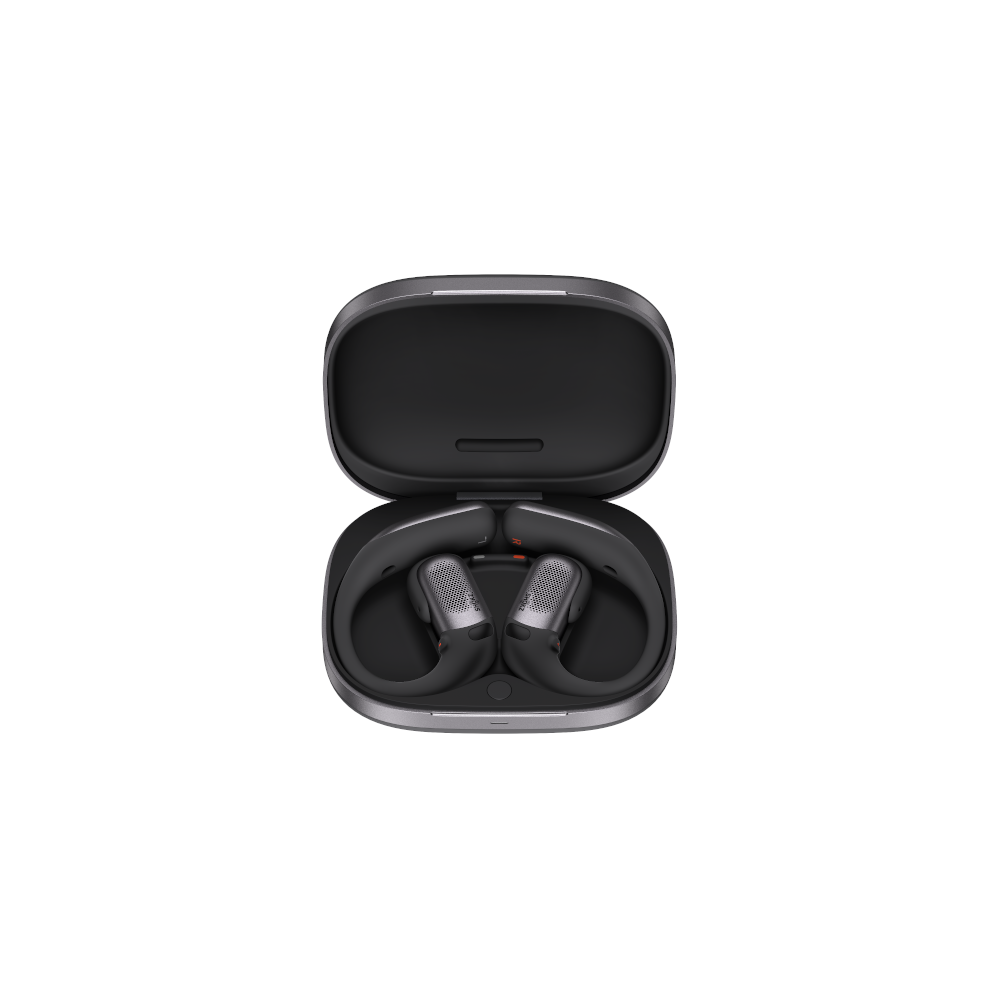
The OpenFit Pro maintains Shokz’s signature open-ear comfort while addressing the fit issues I experienced with the OpenFit 2+. The refined 0.8mm titanium ear hooks feel more secure during movement, and the redesigned contact points feature rubberized sections that grip better without causing discomfort. Unlike previous OpenFit models that position drivers outside your ear’s concha, the Pro’s speaker pods project directly into your ears and make contact with the inner cavity. This significantly improves stability—I could shake my head and do light jumping without the bounce I experienced with the 2+.
However, this increased stability comes with a trade-off: over extended wear, I became aware of that contact point. The OpenFit Pro never became uncomfortable, but they’re not quite the forget-you’re-wearing-them experience of earlier OpenFit models. The ear hooks, wrapped in soft silicone, worked fine even while wearing glasses. Shokz includes optional silicone support loops for smaller ears or those needing extra stability, though I didn’t need them.
The earbuds carry an IP55 rating, meaning they’re protected against water jets and dust ingress. This makes them suitable for sweaty workouts and light rain, though you shouldn’t submerge them.
The charging case uses an aluminum alloy frame that feels premium but adds bulk—it’s significantly larger than a standard AirPods case. You do get wireless charging, which isn’t standard on all open-ear models, plus a USB-C port for wired charging. A 10-minute quick charge provides 4 hours of playback.
Controls are now fully physical buttons (one on each earbud), abandoning the hybrid touch/button system from previous models. This is a welcome change—the buttons are easy to locate and press, and you can customize which button combinations control play/pause, track skipping, volume, and voice assistant access. The OpenFit Pro also includes wear sensors that auto-pause music when you remove an earbud, Shokz’s first ear-hook model with this feature.
What are the best features of the Shokz OpenFit Pro?
Open-Ear Noise Reduction that actually works
The headline feature is Open-Ear Noise Reduction, and it delivers on its promise despite sounding contradictory. A triple-microphone array monitors environmental noise and dynamically adjusts audio playback to reduce background sound without sealing your ear canal. In my testing, conversations a few feet away became noticeably quieter, and ambient office or gym noise got pushed into the background. The reduction is most effective in the mid-frequencies—things like HVAC hum, distant conversations, and treadmill noise.
The system claims an average of 14dB reduction (up to 19dB at certain frequencies), and subjectively, that feels accurate. At even 50% volume, external noise became barely noticeable. You can adjust the noise reduction strength in the Shokz app across multiple levels, though lowering it significantly reduces effectiveness.
The major downside: I experienced persistent pressure sensations similar to early ANC implementations—that uncomfortable feeling of blocked sinuses or inner ear pressure. It’s not painful, but it became distracting during longer sessions. Reducing the noise reduction level in the app helped, but even at lower settings, I still felt some pressure. The sensation subsides somewhat when music is playing, but it’s noticeable enough that some users may prefer to disable the feature entirely.
Dolby Atmos with head tracking
The OpenFit Pro upgrade to “Optimized for Dolby Atmos” mode, which combines spatial audio processing with optional head tracking. The feature works with any content but is most pronounced with actual Dolby Atmos tracks. Vocals and instruments sound more externalized, and there’s a perceptible sense of width and height that doesn’t sacrifice too much dynamic range or loudness. The head tracking is smooth enough for movies, but I found it a bit distracting for music listening.
10-band custom EQ
The Shokz app offers a 10-band custom equalizer (up from 5-band on the OpenFit 2+), providing twice the tuning precision. Five preset modes are available, including a new Privacy Mode that minimizes sound leakage by reducing volume in certain frequency ranges. The EQ interface is straightforward, and adjustments take effect immediately without noticeable latency.
How does the Shokz OpenFit Pro connect?

The OpenFit Pro uses Bluetooth 6.1 with support for SBC and AAC codecs. Notably absent is support for Bluetooth Auracast, which enables both private audio sharing and public broadcasts—a missed opportunity given that open-ear earbuds are ideally suited for scenarios where you want partial ambient awareness alongside electronic audio sources.
Multipoint pairing is supported, allowing you to connect to two devices simultaneously. This works reliably for switching between a laptop and phone, though like most multipoint implementations, there’s a brief delay when switching sources.
Pairing the OpenFit Pro is straightforward:
- Remove both earbuds from the case—they’ll automatically enter pairing mode
- Open Bluetooth settings on your device and select “Shokz OpenFit Pro”
- Download the Shokz app to access features like EQ, noise reduction adjustments, and firmware updates
For multipoint pairing, connect to the first device normally, then manually enter pairing mode (press and hold both buttons for 3 seconds) to connect to a second device.
How long do the Shokz OpenFit Pro’s battery last?
Battery life is strong when noise reduction is disabled, though it takes a significant hit when the feature is active. Shokz claims 12 hours per charge and 50 hours total with the charging case when noise reduction is off. In my testing at higher listening volumes (65-75%), I achieved 9-10 hours per charge, which is still pretty good for open-ear earbuds.
With noise reduction enabled, Shokz claims 6 hours per charge and 24 hours total with the case. Real-world performance will likely land closer to 5 hours at higher volumes. A 10-minute quick charge provides 4 hours of playback, which is handy for topping up between uses.
How well do the Shokz OpenFit Pro cancel noise?
Loading chart ...
The OpenFit Pro achieve roughly 13% total noise reduction with the noise canceling enabled. As open-ear earbuds, they provide essentially zero passive isolation—the pink dashed line shows virtually no attenuation across the frequency range when noise reduction is disabled.
With noise reduction active (blue line), the OpenFit Pro achieve their best performance in the midrange frequencies between 300Hz and 1.5kHz, where attenuation peaks around 13dB. This means the earbuds reduce mid-frequency noise—like conversations, HVAC hum, and office ambient sound—by roughly half. This explains why voices a few feet away become noticeably quieter and background drone gets pushed down in use.
However, the system struggles with both low and high frequencies. Below 200Hz, attenuation drops to near zero, meaning bass-heavy sounds like traffic rumble, airplane cabin noise, or construction equipment remain largely unaffected. Above 2kHz, performance is inconsistent with minimal reduction—high-frequency sounds like keyboard typing, dishes clanking, or sharp voices will still come through clearly.
This targeted midrange reduction makes the OpenFit Pro best suited for office environments or gyms where you want to dampen conversation and background hum without full isolation. They won’t be effective on airplanes, trains, or anywhere with significant low-frequency noise. For comparison, traditional ANC earbuds like the AirPods Pro achieve 80-90% noise reduction across a much broader frequency range.
How do the Shokz OpenFit Pro sound?
The OpenFit Pro sound really good for open-earbuds, with stronger bass and less sibilance or distortion than previous Shokz models.
Reviewer’s notes

Editor’s note: this review uses a hover-enabled glossary to describe sound quality based on a consensus vocabulary. You can read about it here.
Can you use the Shokz OpenFit Pro for phone calls?
Yes, the OpenFit Pro deliver excellent call quality in most environments, with the triple-microphone array effectively handling background noise in typical scenarios.
Shokz OpenFit Pro microphone demo (Ideal conditions):
How does the microphone sound to you?
Shokz OpenFit Pro microphone demo (Office conditions):
Shokz OpenFit Pro microphone demo (Street conditions):
Shokz OpenFit Pro microphone demo (Windy conditions):
Shokz OpenFit Pro microphone demo (Reverberant space):
The OpenFit Pro handles most real-world scenarios well, with particularly impressive performance against street noise and reverberant spaces. Office sounds like keyboards and appliances remain audible but don’t obstruct your voice. However, wind is a dealbreaker—strong gusts completely drown out speech, making outdoor calls impossible on windy days. This is a common limitation of open-ear designs where microphones are more exposed to wind interference. If you frequently take calls outdoors in windy conditions, sealed earbuds with better wind protection would be a better choice.
Should you buy the Shokz OpenFit Pro?

The OpenFit Pro delivers effective noise reduction on open-ear earbuds, but whether that justifies the $250 price tag depends on your specific needs and tolerance for ANC. To my ears, these are Shokz’s best-sounding open-earbuds yet—the stronger bass and less harsh treble are improvements over the OpenFit 2+, and the more secure fit addresses my stability issues with previous models.
However, the noise reduction feature that defines this product comes with significant caveats. The persistent pressure sensation I experienced makes it uncomfortable enough that you might disable the feature entirely, at which point you’re paying $50 extra for earbuds that sound only marginally better than the OpenFit 2+. The noise reduction is effective in the narrow midrange band where it works—dampening office chatter and HVAC hum—but it won’t help with bass-heavy sounds like traffic or airplane noise, and high-frequency sounds still come through clearly.
If you already own the OpenFit 2+ or any recent Shokz open-ear model, skip this. The improvements don’t warrant the upgrade cost, especially if the noise reduction causes you discomfort. If you’ve been waiting for open-ear earbuds that reduce ambient noise without full isolation, the OpenFit Pro is the first to attempt it. But the sweet spot buyer is someone who wants open-ear comfort for office work or gym sessions and needs some noise dampening without full isolation. The excellent call quality (wind aside) and strong battery life make these solid daily drivers if you can work around the ANC limitations.
Would you buy the Shokz OpenFit Pro?
What should you get instead of the Shokz OpenFit Pro?

- Shokz OpenFit 2+ ($249.95 at Manufacturer site): If you don’t need noise reduction, the OpenFit 2+ delivers excellent open-ear sound and superior comfort without the pressure sensation. The sound quality difference is noticeable but not transformative, making the 2+ the smarter buy for most people. It’s $50 less and you get essentially the same experience minus the ANC complications.
- Bose Ultra Open Earbuds ($299 at Amazon): For $50 more, Bose’s clip-style design offers better spatial audio implementation and comparable sound quality with a more refined fit. You lose the noise reduction feature, but you also avoid the pressure sensation entirely. Battery life isn’t quite as strong, but the overall polish is higher.
- Shokz OpenDots One ($199.95): If you prefer clip-style earbuds (particularly useful with glasses), the OpenDots One deliver similar sound quality in a more compact package. You lose the noise reduction and improved bass response of the Pro, but you save $50 and get a more portable case. SoundGuys’ full review coming soon.
Thank you for being part of our community. Read our Comment Policy before posting.