All products featured are independently chosen by us. However, SoundGuys may receive a commission on orders placed through its retail links. See our ethics statement.

Apple's new HomePod mini 2 isn't very smart (yet)
Nov 6, 2026 — 4:00 AM ET
Apple HomePod mini 2


The HomePod mini 2 is the first update to Apple’s smallest smart speaker since 2020, and it has a lot to prove. Apple has never been a major player in this category, and its biggest rivals have spent the past year rebuilding their speakers around AI assistants.
Among US households that bought a smart speaker in a recent six-month window, Parks Associates found that 60% chose an Amazon device, 18% chose Google, and just 8% chose an Apple HomePod.
To win over more of those buyers, the HomePod mini 2 needs to do three things as well as or better than the competition: be easy to use, sound good, and actually be smart. I’ve been using it in my kitchen and bedroom to see how it does on all three.
The HomePod mini 2 makes the most sense for people already deep in Apple’s ecosystem who want a compact speaker for a kitchen, bedside table, or desk. It’s an especially easy pick if you have a Mac with Wi-Fi 6E and want wireless desktop speakers, or if you plan to build a surround setup around the new Apple TV 4K. If you’re buying a smart speaker mainly for a smarter voice assistant, you’ll want to wait.
What’s new with the HomePod mini 2?

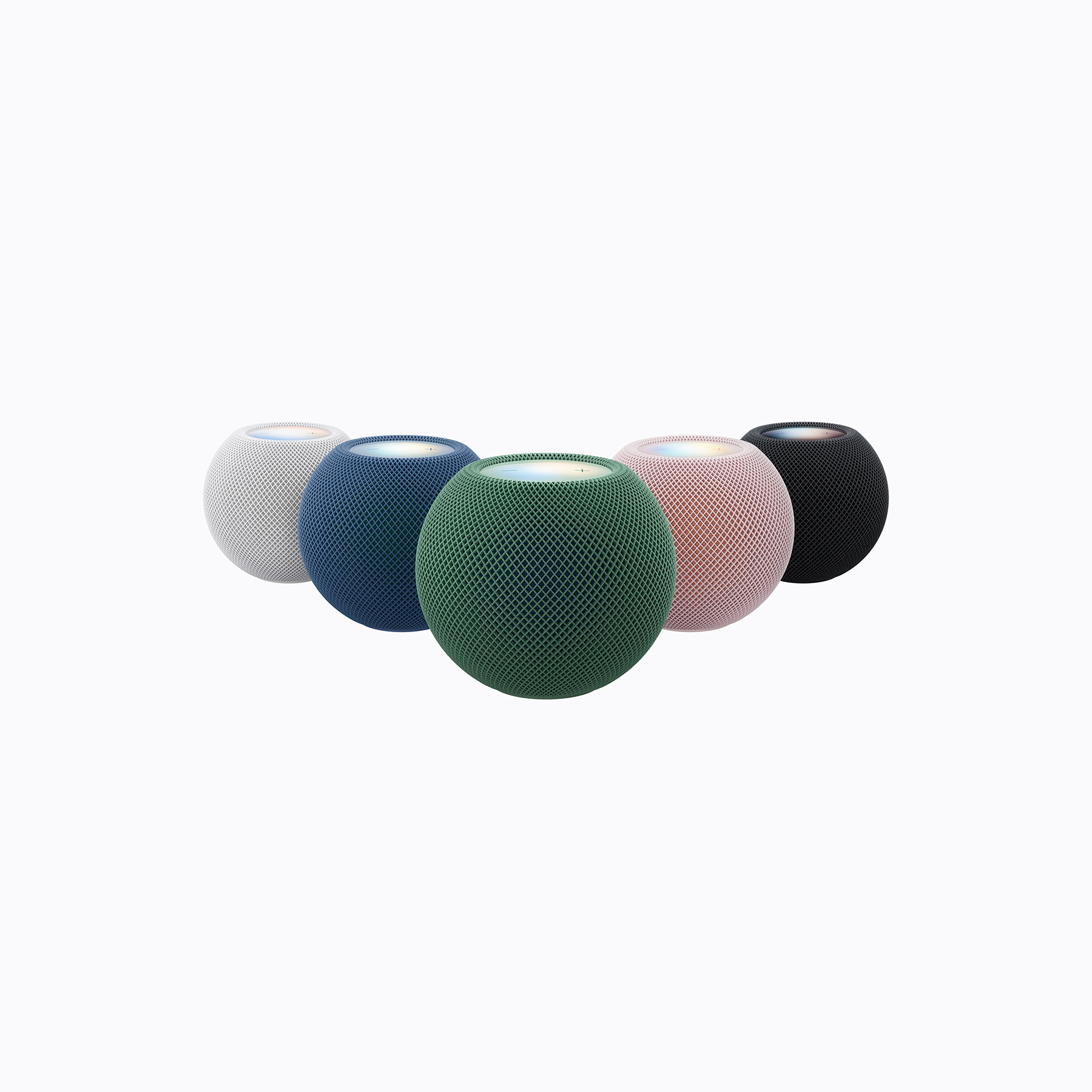
The HomePod mini 2 looks almost exactly like the original from 2020, down to the size and shape, though Apple has refreshed the colors: white, pink, green, blue, and midnight.
The real changes are under the hood:
- S10 chip: Replaces the original’s S5 and handles Apple’s computational audio, which adjusts dynamic range and loudness in real time.
- Wi-Fi 6E and Bluetooth 6: Up from Wi-Fi 4 and Bluetooth 5.0, which in plain terms should mean more reliable connections to your network, smart home devices, and other Apple gear.
- Mac speaker support: The HomePod mini 2 can now be set as a Mac’s default audio output.
- Four-speaker surround: Four HomePod mini 2 units can form a home theater setup with the Apple TV 4K (4th generation).
- Sound Glow: The top of the speaker lights up and animates along with your music.
- Siri AI: Apple’s headline feature, which is coming later in a software update. More on that below.
Is the HomePod mini 2 easy to use?

Yes. Setup took me less than five minutes, and everything is managed in the Home app on your iPhone. From there, you can see your alarms and timers and adjust settings for Siri, the touch controls, and more.
Once it’s up and running, using the HomePod mini 2 with other Apple devices is dead simple. I love that I can walk in the door and just hold my phone near the speaker to hand off whatever I’m listening to. It’s a small feature, but it shows off how tightly Apple’s devices work together.
Setup took less than five minutes, and handing music off from your iPhone is as easy as it gets.
None of that is new, though. What is new is the upgraded wireless hardware, and the most useful thing it unlocks is Mac support. You can now set the HomePod mini 2 as your Mac’s default speaker, as long as your Mac has Wi-Fi 6E or later, which Apple started adding to Macs in 2023. I tried this while cooking in the kitchen and was surprised by how well it worked. Audio and video stayed in sync the whole time I was streaming shows and movies. I noticed a brief delay when pausing or resuming a video, but otherwise it was a smooth experience. Not every reviewer has had the same luck getting the feature to work, so your mileage may vary.
You can also stereo pair two HomePod mini 2 units for your Mac. And if you want to go further, four of them can act as a surround system for your TV, though that requires the new Apple TV 4K (4th generation). At US list prices, four HomePod mini 2 speakers and the $299 Apple TV 4K add up to $895 before tax. That’s a lot of money, but the option is there if you want it.
How does the HomePod mini 2 sound?

Kick drums and bass lines come through clearly, and I was genuinely surprised by how much bass this little speaker can produce. At one point, I placed it in the corner of my bedroom, and the room boosted the low end so much that I had to turn on the Reduce Bass setting in the Home app.
The mids are fine. Pianos and vocals come through clearly, though they can get drowned out by bass instruments on instrumentally busy tracks. As for the treble, high-pitched synth leads in some hyperpop and EDM songs, like those by Ninajirachi, came across a little too loud for my taste. Guitars and strings sounded clear, though, and I could easily follow melodies.
There’s a surprising amount of bass in a speaker this small, sometimes too much.
Unfortunately, Apple doesn’t give you an EQ to adjust any of this. That’s especially annoying because Apple just added custom EQ to AirPods with iOS 27. It’s another case of Apple having the ability to do something and choosing not to.
As for volume, the HomePod mini 2 gets loud, as in “the neighbors might complain” loud, and it does a good job of avoiding distortion even at max volume. It’s a great fit for casual listening in a kitchen or bedroom, but if you want a speaker to anchor a party, look elsewhere.
The other new feature you’ll notice is Sound Glow, which makes the lights on top of the speaker pulse and glow along with your music. It looks nice, but since I’m usually doing something else while I listen, I rarely notice it. It’s a nice-to-have, not a must-have, and it isn’t exclusive to the mini 2 anyway: Apple is bringing Sound Glow to the original HomePod mini and the second-generation HomePod through a software update.
Is the HomePod mini 2 actually smart?
So the HomePod mini 2 is easy to use and sounds good. But is it smart enough to compete with Amazon and Google?
On paper, the S10 chip makes it ready for Siri AI, which Apple says is more conversational, has broader world knowledge, and understands your personal context. In short, it’s supposed to answer questions far better than any Siri before it.
So I put it to a simple test. I ran out of cake flour while baking and asked the HomePod mini 2 what to do if I don’t have cake flour. The answer wasn’t helpful. I asked my first-generation Google Home Mini, a speaker Google released back in 2017, the same question, and it gave me a useful substitute. How can a speaker that’s nearly a decade old handle that question when Apple’s brand-new one can’t?
A Google speaker from 2017 answered a question the brand-new HomePod mini 2 couldn’t.
The answer is that the HomePod mini 2 doesn’t have Siri AI yet. Apple confirmed at launch that Siri AI will arrive on the speaker in a future software update, without giving a date. When it does arrive, it will only be in English, and only in the US, Canada, the UK, Australia, India, New Zealand, Singapore, and South Africa. Requests that rely on personal context will also need an Apple Intelligence-enabled iPhone or iPad. It’s an odd decision considering the new Apple TV 4K and Apple’s HomeView smart display both ship with Siri AI on November 13.
In other words, Apple launched a smart speaker without the “smart” part. The current Siri can still turn off your lights, play music, and set timers. But for anything that takes a bit more thinking or personal context, it’ll tell you to ask Siri on your iPhone instead, which defeats the purpose of buying a HomePod mini 2.
In fact, when I asked Siri on my iPhone, which does have Siri AI, the same cake flour question, it gave me a good answer right away. So, until that update lands, you could just as easily buy a regular Bluetooth speaker, pair it with your phone, and get a smarter assistant that way.
To add salt to the wound, the HomePod mini 2 costs $149. That’s $50 more than the original HomePod mini cost when it launched in 2020, and $20 more than Apple was charging for it after a price hike earlier this year.
Should you buy the Apple HomePod mini 2?

Does it make life more convenient? Yes. Does it sound good? Yes. But is it really smart? Until Siri AI arrives, not compared to other smart speakers in 2026. The hardware is good, and Apple’s speaker hardware has always been more than decent. It’s the smart part where Apple is still playing catch-up.
The hardware is ready to compete with Amazon and Google. Siri AI isn’t, at least not yet.
If you want wireless speakers for a Wi-Fi 6E Mac or plan to build an Apple TV surround setup, the HomePod mini 2 is worth a look today. If you already own an original HomePod mini and don’t need either of those features, there’s little reason to upgrade until Siri AI actually shows up.
Apple’s speaker hardware is ready to compete with Amazon and Google. Whether the HomePod mini 2 wins over more buyers now comes down to how good Siri AI is when it finally arrives, and how long Apple makes owners wait for it.
What should you get instead?

If you want a smarter assistant right now, consider the Google Home Speaker. It costs $99.99, has Google’s Gemini assistant built in today, and offers 360-degree sound and stereo pairing. Keep in mind that the most advanced Gemini features, like Gemini Live, require a Google Home Premium subscription, which costs $10 per month after a six-month free trial.
Frequently asked questions
Not yet. Apple says Siri AI will come to the HomePod mini 2 as a free software update but hasn’t said when. Until then, it runs the existing version of Siri.
No. Apple’s stereo pairs require two speakers of the same model, so you’ll need two HomePod mini 2 units.
Any Mac with Wi-Fi 6E or later, which covers models Apple released from 2023 onward. You can use a single HomePod mini 2 or a stereo pair.
Yes. Four-speaker surround sound requires the Apple TV 4K (4th generation) and four speakers in matching front-and-rear pairs, using HomePod mini 2 or HomePod (2nd generation) units.
Conversation
Read what readers said or add your take.