All products featured are independently chosen by us. However, SoundGuys may receive a commission on orders placed through its retail links. See our ethics statement.
JBL Go 5 vs JBL Clip 5: Same family, different adventures
May 7, 2026 — 6:00 AM ET
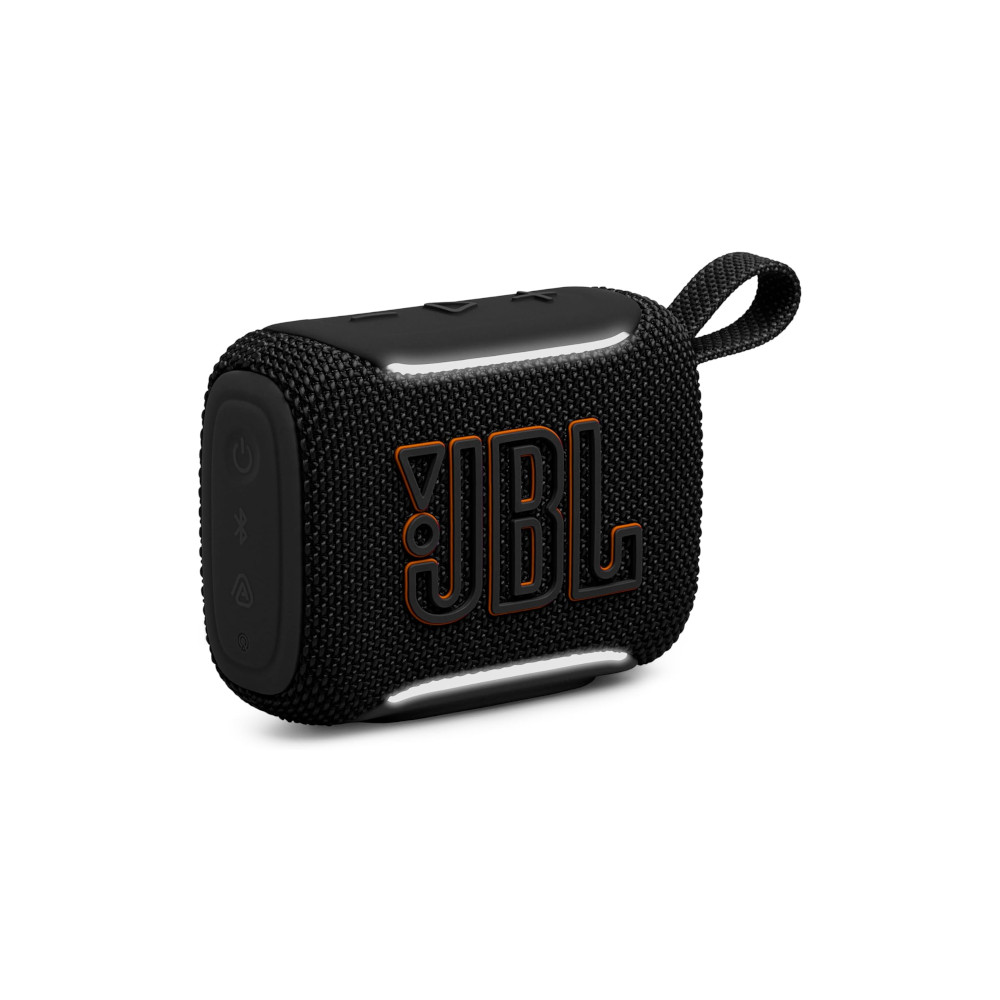



The JBL Go 5 and JBL Clip 5 are both small, rugged, outdoor-ready Bluetooth speakers from JBL, but they’re built around different ideas of what “portable” means. The Go 5 is as small as it gets: a pocketable square you toss in a bag and forget about. The Clip 5 is a bit bigger and pricier, but it comes with a built-in carabiner that lets you hang it from a bag strap, bike handlebar, or tree branch without any extra gear. If you’re deciding between the two, the choice mostly comes down to how you want to carry your speaker — and how much you want to spend.
What’s it like to use the JBL Go 5 compared to the JBL Clip 5?
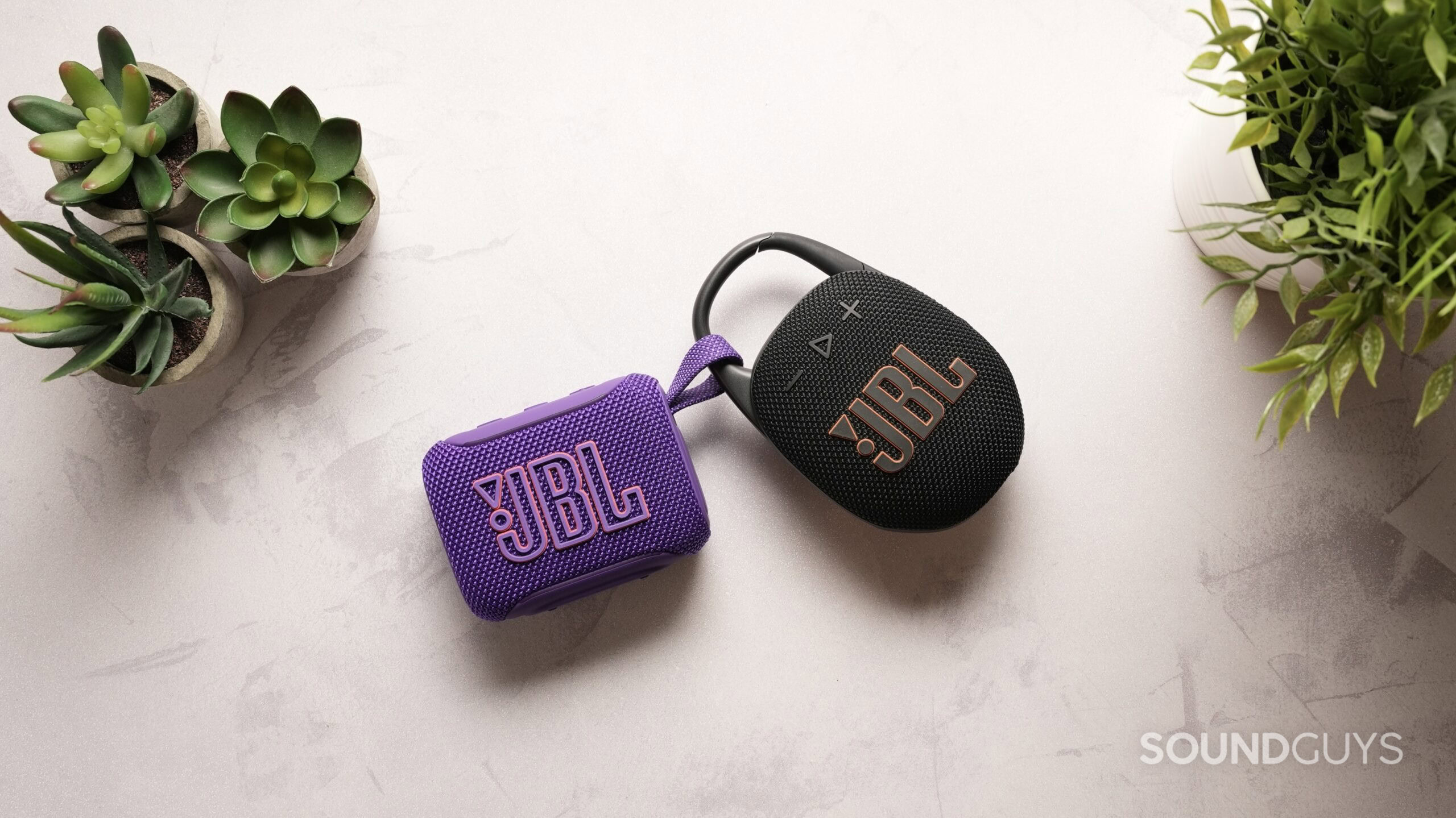
Both speakers are designed for casual, on-the-go use, and neither is going to fill a room with sound or seriously compete with a larger speaker.
The Go 5 is the smaller of the two — a compact, square-but-rounded speaker that slips into a jacket pocket or the side of a bag without taking up much real estate. It has a built-in loop for attaching to things, but it’s a simple fabric strap rather than a proper clip. JBL added ambient lighting strips to the front of the Go 5 this time around, which gives it a bit more personality than you’d expect from something so small.
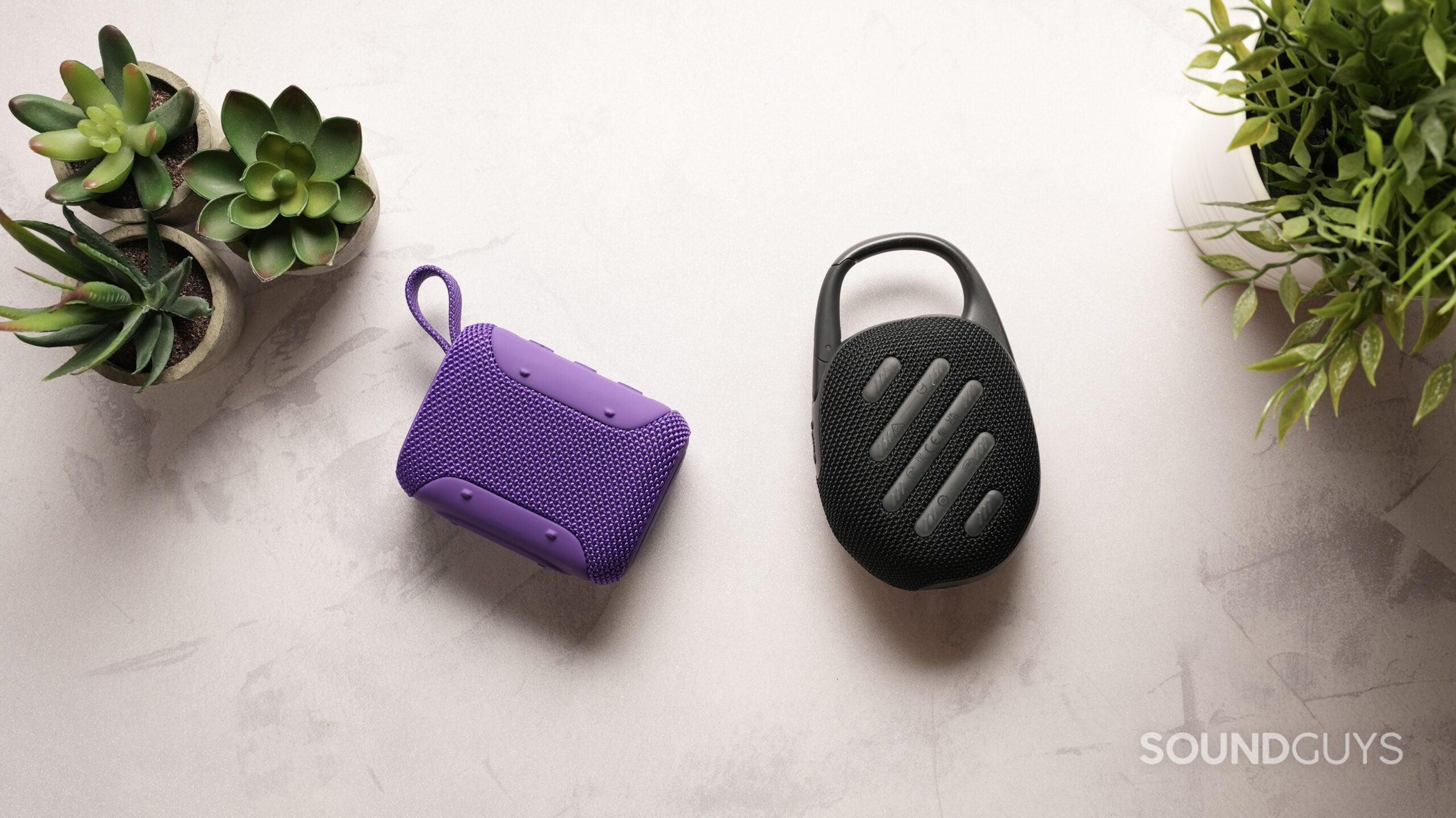
The Clip 5 is taller and narrower, shaped to accommodate its signature built-in carabiner. That carabiner is the defining feature — it’s wide enough to clip onto most bag straps or hooks, and the speaker also lays flat thanks to thicker silicone padding on the back. It doesn’t have lighting, but it feels like it’s been designed for outdoor use, where you want your speaker attached to something rather than sitting on a surface.
Build quality is strong on both. The Go 5 carries an IP68 rating (dust- and water-resistant, submersible), which edges out the Clip 5’s IP67 rating. In practice, both are durable enough for rain, splashing, and outdoor adventure. The Go 5 weighs 230g; the Clip 5 weighs 285g. Neither is heavy, but the Go 5 is slightly easier to forget you’re carrying.
How do you control the JBL Go 5 and JBL Clip 5?
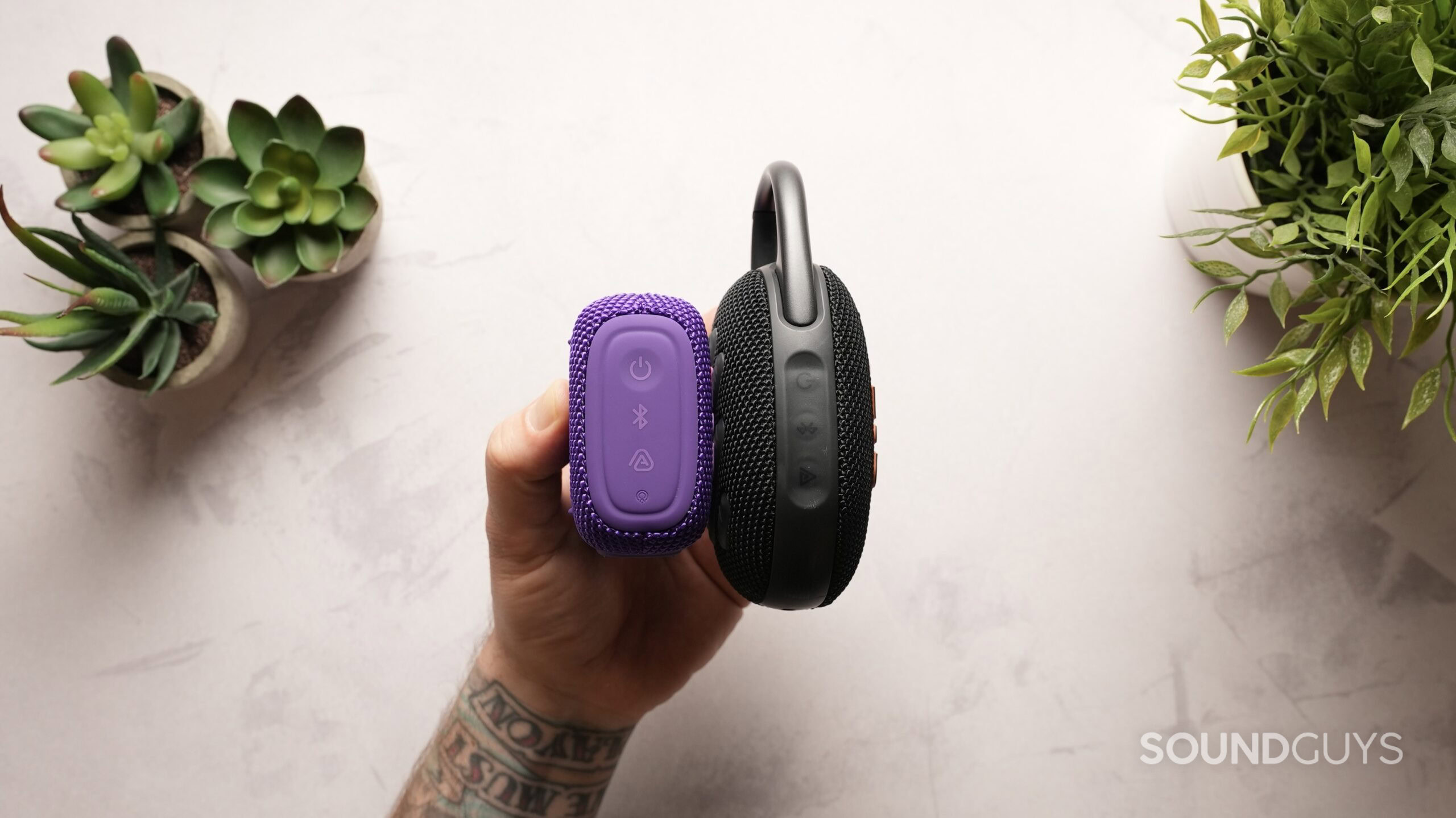
Both speakers keep controls simple. The Go 5 has playback buttons on the front, along with a dedicated AirTouch button on the side for instantly pairing a second Go 5 in stereo — more on that below. The Clip 5 also has playback controls on the front, with Power, Bluetooth, and Auracast buttons recessed into a rubberized silicone strip on the side. Neither speaker has a built-in microphone, so neither can be used for phone calls.
How does the app experience compare?
Both speakers work with the JBL Portable app, and it’s worth downloading for either one.
The Go 5 gets the more fully-featured app experience here. It has a 7-band custom EQ — an upgrade over the 5-band on the Go 4 —, and while you can’t change the color of the ambient lighting, you can choose from preset lighting themes that adjust how the lights behave. The Clip 5’s app support is a bit leaner. You get a 5-band EQ with some preset sound modes and a customizable option.
Both speakers support Playtime Boost, which cuts the low end to extend battery life. It’s useful in a pinch, but the speaker sounds noticeably thinner as a result, though not something you’d want to run regularly.
Both speakers support stereo pairing with a second identical unit — two Go 5s or two Clip 5s together, but not one of each. So, if you connect to other JBL speakers via Auracast, the connection stays in mono, and your EQ settings automatically reset to JBL’s default Signature mode on both speakers.
How do the JBL Go 5 and JBL Clip 5 connect?
The Go 5 connects over Bluetooth 6.0 and supports SBC, AAC, and LC3 codecs. The Clip 5 uses Bluetooth 5.3 and is SBC only. In practical terms, the codec difference is unlikely to be audible on speakers at this size and price — but the Go 5 has the edge on paper, and Bluetooth 6.0 is a newer, more capable standard.
Both speakers support USB-C charging. The Go 5 also supports wired audio playback over USB-C, which is a minor convenience feature most people won’t use. The Clip 5 doesn’t have a wired audio option.
Both speakers can connect to two devices at the same time, though it isn’t true multipoint — you’ll need to manually switch between sources rather than audio handing off automatically. And both speakers support Auracast, which lets you link multiple compatible JBL speakers together.
Is battery life better on the JBL Go 5 or JBL Clip 5?
The Clip 5 wins here. JBL rates it for up to 12 hours of playback per charge, compared to the Go 5’s 8 hours. The Clip 5 is a bigger speaker with more room for a larger battery, so this isn’t a surprise.
If battery life is a priority — say, you’re spending a full day outdoors — the Clip 5 has the advantage. The Go 5’s 8 hours of battery life is still reasonable for most casual use, but it won’t last all day at higher volumes.
Does the JBL Go 5 sound better than the JBL Clip 5?
At this size category, it’s less about which sounds “better” and more about which sounds good enough for what you need.
The Go 5 delivers decent clarity and acceptable bass for personal listening. It works well as a small desk speaker or a shower companion for podcasts and casual music, but it’s not designed to project across a group. At higher volumes, the midrange gets harsh. It’s a mono speaker with a 45mm driver and 4.8W of output, and those physical limitations define the ceiling more than anything else. Pairing two Go 5 speakers using the AirTouch feature makes a noticeable difference for width and clarity, and it’s honestly the way to go if you’re willing to invest in a pair.
The Clip 5 has more headroom with its 7W output and 1.75-inch driver, and it handles things like layered guitars and dynamic tracks with a bit more ease. There still isn’t much stereo separation — it’s a mono speaker — and cranking it to max introduces some shrill treble. Using the 5-band EQ to nudge up the low end and treble helps bring out more detail and bass depth. It’s a more capable speaker for small group use than the Go 5, but not dramatically so.
Overall, the Clip 5 has a slight edge in output and low-end presence. Neither speaker is something you’d want to subject to critical listening, and both are best enjoyed with realistic expectations about what a speaker this small can do.
Should you get the JBL Go 5 or JBL Clip 5?
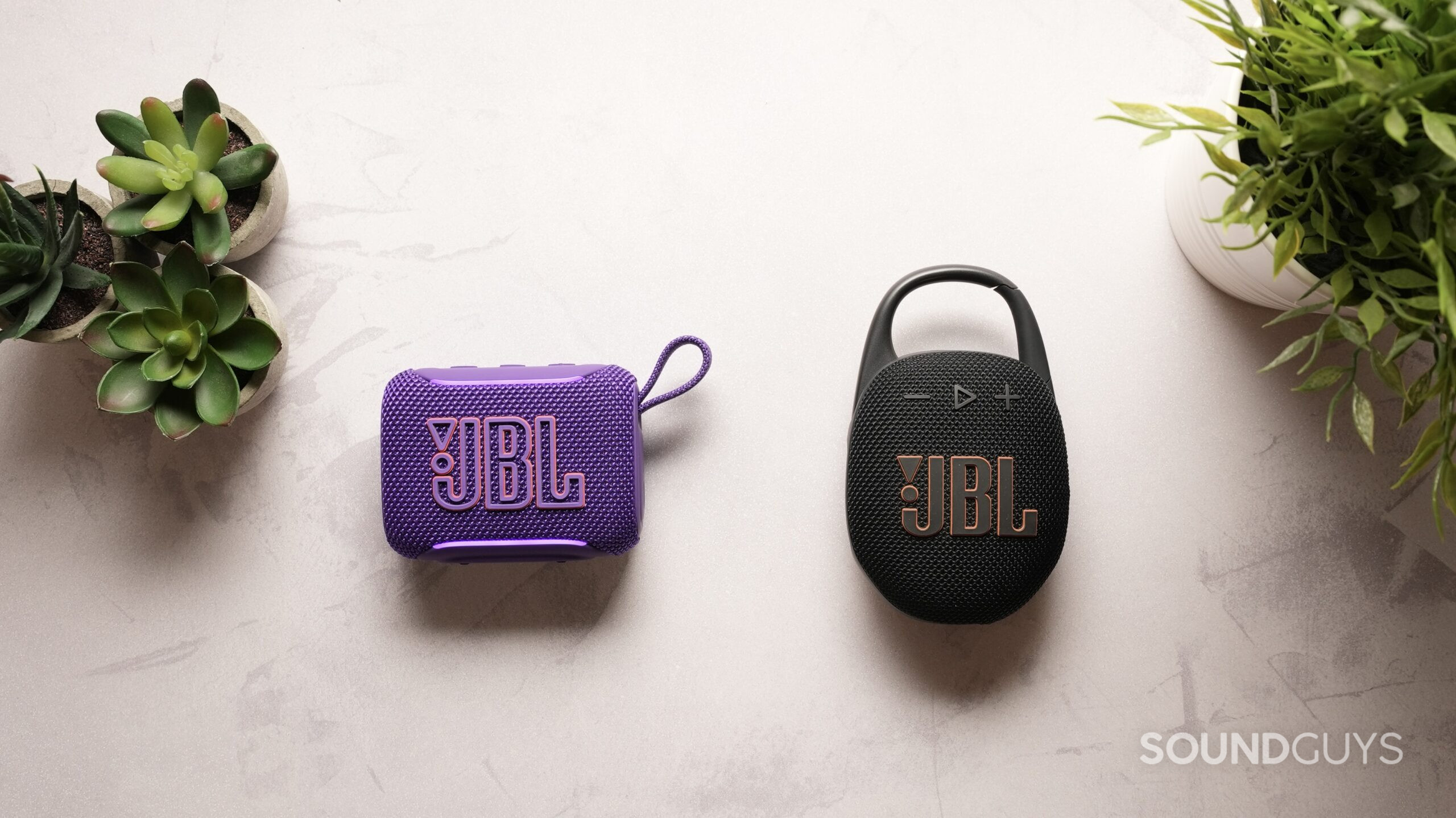
If you want the most portable option possible and price is a factor, the Go 5 is the pick. It’s lighter, smaller, IP68-rated, and has the newer Bluetooth standard. The ambient lighting is a fun touch, and the 7-band EQ gives you more sound customization than the Clip 5. If you plan on buying two to run in stereo, the AirTouch pairing makes that setup painless.
If you want a hands-free speaker you can physically attach to your gear — a backpack, a bike, a tent loop — and you want more battery life and a bit more volume, the Clip 5 earns the extra $25. The carabiner is genuinely useful, the 12-hour battery life has a real advantage over a full day out, and it outputs a little more power.
- The short version: Go 5 for pockets and bags, Clip 5 for clipping onto things and staying out longer.
Ambient lighting
7-band EQ
Lightweight and easy to carry
AirTouch for quick pairing a second Go 5
What should you get instead of the JBL Go 5 and JBL Clip 5?

If you’re considering the Go 5, it’s also worth looking at the JBL Go 4 ($49.95 at Amazon). With the Go 5 now out, the Go 4 is likely to see discounts. You give up the ambient lighting, the 7-band EQ, and the AirTouch pairing, but if you catch it on sale, buying two Go 4s for a stereo setup could be a smart move.
For something even cheaper and no-frills, the Soundcore Select 4 Go ($34.99 at Amazon, often on sale for around $19.99) is a solid option if you just want a small, casual speaker without spending much.
If you want to step up from either speaker, the JBL Grip ($99.95 at Amazon) is the next rung — a cylindrical, can-shaped speaker with 16W of output, IP68, a 7-band EQ, and ambient lighting that outperforms the Clip 5 on bass precision and treble clarity. And if you want to go bigger still, the JBL Flip 7 ($149.95 at Amazon) is a major leap in power at 35W.
Thank you for being part of our community. Read our Comment Policy before posting.